Electroculture Decoded
A guided tour of the Common Electroculture Application diagram: every part, every technical term, and what each one does.
The big idea, in one minute
Imagine the sky and the ground are the two ends of a very large, very gentle battery. On a fair day the air above us is slightly positive and the ground is slightly negative. That difference is measurable: roughly 100 volts for every metre of height. Between them a faint but real electric current flows all the time, known as the fair-weather current, part of the Earth’s natural electrical circuit. That is the sky-and-ground battery. The antenna also holds a small real battery of its own, called the voltaic stack.
Electroculture is the practice of giving that natural flow a tidy path, using a tall copper antenna, a galvanised steel wire in the ground and some coils and magnets, so that it runs through the soil beneath your plants. Growers who use it report faster, greener growth and less pest and disease pressure, and we see it work on our own land. The diagram below shows how the parts fit together. Follow the numbers.
Every explanation is tagged, so you know what is measured, how it works and what growers see.
Established physics and chemistry. You can check it with a meter.
The electroculture explanation, as set out by the researchers and growers who developed it.
What growers see on their own land, season after season.
The diagram
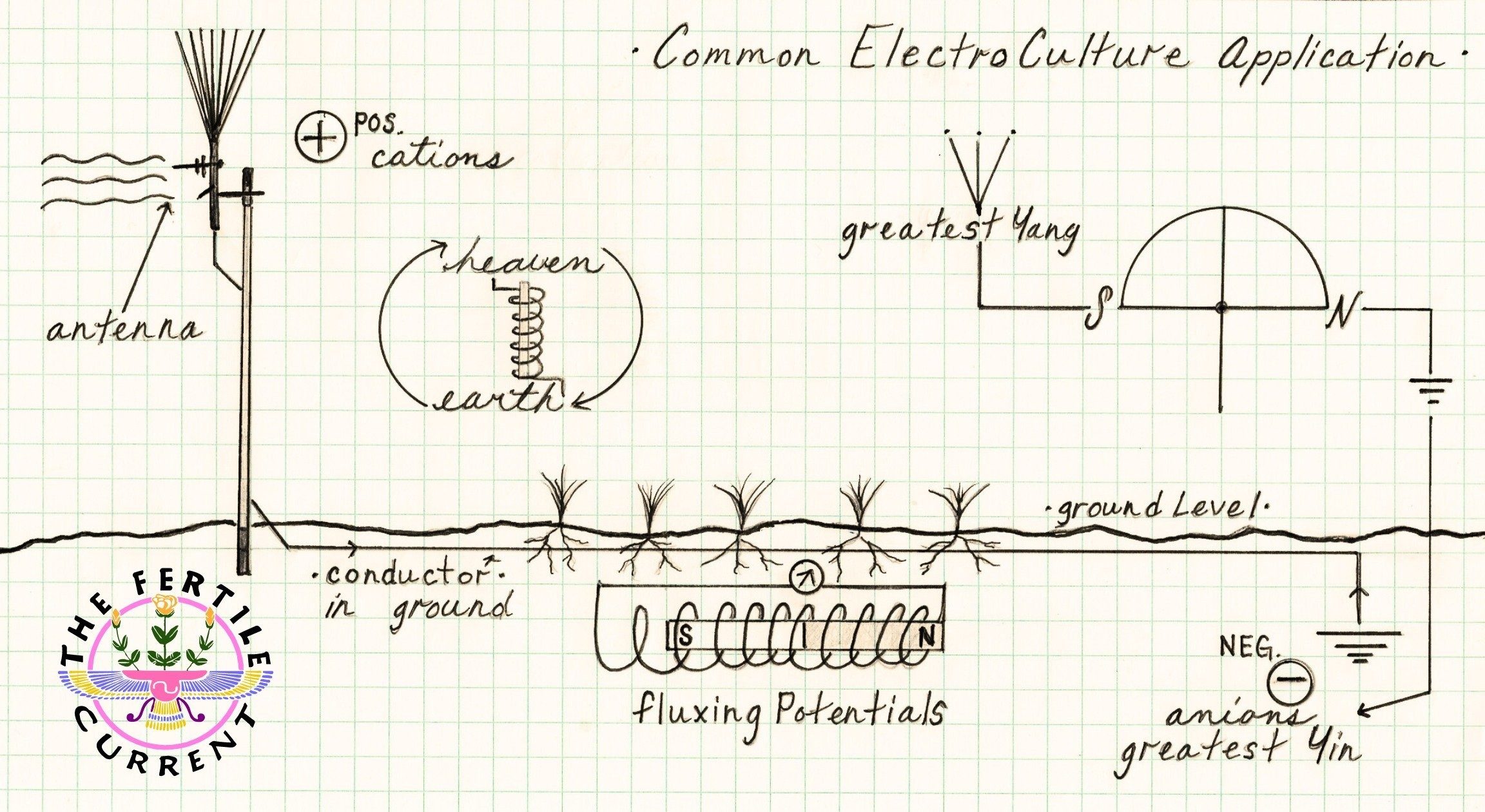
Follow the numbers
The antenna
In plain words: the spears catch the charge, and the copper carries it.
A bundle of thin steel “spears” on top of a copper body, standing tall in the air. Steel is ferromagnetic, and the spears give lots of surface for meeting the air. The copper body is a very good conductor, so charge keeps moving through it, and it is diamagnetic, which means magnets barely notice it. Height matters: the air’s voltage rises by roughly 100 volts for every metre, so the higher the antenna, the more difference there is to work with.
Positive ions in the air (+ cations)
In plain words: the air carries positive charge, and the antenna gathers it.
Ions are atoms or tiny particles that carry a small electric charge. A cation is a positive (+) one. On a fair day the air carries a positive charge and the earth a negative one, and opposites attract. That pull is electrical, not magnetic. The antenna’s spears are designed to gather these positive ions and pass their charge down into the copper.
The ground wire: galvanised steel
In plain words: the ground wire carries the charge into the soil and completes the loop.
A length of galvanised steel wire runs through the soil, south to north in a straight line (use a compass), about 20–30 cm down. That puts it just under the roots, in the rhizome layer. Galvanised means coated in zinc, so it does not rust away underground. A brass coupler joins it to the antenna. This wire completes the circuit: without it there would only be the sky half.
Plants, roots and living soil
In plain words: the roots and the soil life sit right above the wire, where the effect is felt.
The roots sit just above the wire, in the busiest layer of the soil. Plants take their food in as ions, some positive (calcium, potassium, magnesium) and some negative (nitrate, phosphate). The soil is also full of tiny living things that trade in electric charge: microbes get their energy by passing electrons from one thing to another. How it works: the back-and-forth of positive and negative charge from the circuit, the “fluxing potentials”, gives this living soil a gentle, varied stimulus and invites a richer mix of soil life. Growers who use it report faster, greener growth and less pest and disease pressure.
Coil and magnet: “fluxing potentials”
In plain words: a coil and magnet turn a rising-and-falling flow into a changing magnetic field, and back into a small voltage.
This is the general idea in the drawing: wire wound round a magnet. A current in a wire makes a magnetic field around it, and coiling the wire stacks that effect in one place. The voltage from sky to ground keeps rising and falling (the “fluxing potentials”), so the magnetism through the coil rises and falls too. That changing amount is the flux, and a changing flux makes a small extra voltage back in the wire. That is induction, the way a bike dynamo works. In our range the magnetic side is the aligned rare-earth magnets inside the antenna, plus the optional Magnetic Signal Boosters threaded on the ground wire.
The Heaven – Earth loop
In plain words: sky is plus, earth is minus, and the energy goes round between them.
The little circle with a coil in the middle is the whole idea in one picture. Heaven is the positive (+) end: the sky and the antenna. Earth is the negative (−) end: the ground. Energy travels round the loop between them, like water circulating round a fountain, and the coil guides and shapes the flow. It is the same Yang and Yin as in callout 8.
The earth connection and negative ions
In plain words: the earth end completes the loop. Without both ends the circuit is not complete.
The short stacked lines are an electrician’s symbol for ground: this end is connected into the earth. An anion is a negative (−) ion. The earth end is the calm, receptive end, and the antenna end is the active end. You need both. A circuit only works as a complete loop, like a torch that will not light with only one wire to the battery. An antenna with no ground wire has only the sky half, and a ground wire with no antenna has only the earth half. Closing the loop is what lets the potentials flux through the soil, and it is the part most often missing.
Compass, Yang and Yin
In plain words: the compass shows it is laid out south to north, and plus and minus never stand still.
The compass shows the whole system is laid out south to north, the same way the Earth’s magnetic field runs. The tai chi symbol shows two opposites that need each other. Yang is the plus (+) side: the sky end, where the antenna is. Yin is the minus (−) side: the earth end. The size of the difference between plus and minus is called the voltage, and it is never still. It grows and shrinks, like the tide coming in and going out, or like breathing in and out. That rising and falling is what travels along the ground wire and through the soil under the roots. That is what “fluxing potentials” means.
Ions in three pictures
1. A balanced atom
Equal plus and minus. No charge overall.
2. Lose an electron
More plus than minus, so it turns positive: a cation (+).
3. Gain an electron
More minus than plus, so it turns negative: an anion (−).
Flux in three pictures
1. A current makes a field
Electricity flowing in a wire makes rings of magnetism around it.
2. A coil stacks it up
Winding the wire into a coil gathers all those rings into one place.
3. A change makes a voltage
When the field rises and falls, a small voltage appears back in the wire. Steady means nothing happens.
Lining it up with the Earth
The Earth is a giant magnet, with its field running north to south. A compass needle lines itself up with it. The system is laid out the same way: the ground wire runs south to north, with the antenna at the south end and the earth connection at the north end. Lay it out with a compass.
The small parts follow the same rule. The telluric rod is aligned to the South, the resonator ring’s gap faces North, and the red dot on each optional magnet booster (magnetic south) faces south, toward the antenna.
Magnetic Signal Boosters are an optional extra: stacks of magnets threaded on the ground wire before it goes into the trench.
Two natural currents
Fair-weather current
Flows downward, from the upper air to the ground, on calm days. It is a faint but real part of the Earth’s natural electrical circuit, and scientists measure it. The antenna’s spears and air-side parts work with this one.
Telluric current
Flows sideways, through the ground itself, driven by shifts in the Earth’s magnetic field. Geologists use it to map what lies underground. The brass telluric rod is the part that works with this one.
After the storm
Many growers notice a flush of green after an electrical storm. Part of that is well understood: lightning splits the nitrogen in the air, and rain carries the resulting nitrogen compounds down to the soil as natural plant food.
Chris’s guide compares the faster, greener growth that growers report from electroculture to that same flush of green after a storm.
How it works: electroculture is a gentle, everyday version of the same thing: it gives the sky-and-earth circuit a path through your soil all the time, not only during a storm.
Why these metals, and why up high?
Why copper and steel
The body, wire and hardware are copper and brass. Copper is the best everyday conductor, so charge keeps moving, and it lasts outdoors: it just turns green on the surface instead of rusting through. The spears are steel, which is ferromagnetic and gives lots of surface to meet the air.
Why up high
On a calm, fair day the air’s voltage rises by roughly 100 volts for every metre above the ground. The higher the antenna reaches, the bigger the difference between the air at its tip and the earth. A 5 metre antenna reaches air roughly 500 volts above the ground, a 3 metre one about 300. A bigger difference is more push, like a taller water tank. The CW1+ is made for 4–5 metres or more, and higher performs better.
Why points
Electric charge crowds onto sharp points, which is why lightning rods are pointed. The bundle of thin steel spears gives the antenna a great many points to meet the air, so it has more chances to gather charge.
Think of the body
At the centre of you sits an organ whose own electrical and magnetic field is the strongest you have. Doctors read it every time they take an ECG, and it loops round like a donut, just as the Earth’s field does. The body’s circulation runs in a loop too, with no beginning and no end.
Electroculture is the idea that a garden can run in the same kind of loop: down the antenna from the sky, along the ground wire, through the soil and roots, and back round again. The Heaven–Earth circle in the diagram is that loop in miniature.
Where does basalt fit in?
In plain words: the ground wire is a single line. The basalt spreads the effect out, so more of the bed is part of the circuit.
Basalt is a dark volcanic rock. Crushed into a fine powder it is called rock dust, and growers spread it on soil like a mineral top-dressing. It contains iron-bearing minerals, which makes it paramagnetic: very weakly pulled towards a magnet. Researcher Philip Callahan measured how paramagnetic different rocks and soils are, and basalt is among the strongest. Damp soil with dissolved minerals also carries tiny electric currents.
How it works: basalt dust spread across the bed gives the flowing charge a wide, receptive surface to work with, instead of one narrow line. Growers typically spread about 1 kg of rock dust per square metre. The same rock fills the core of the antenna, where it is there to attract positive ions.
What is inside a Living Field antenna
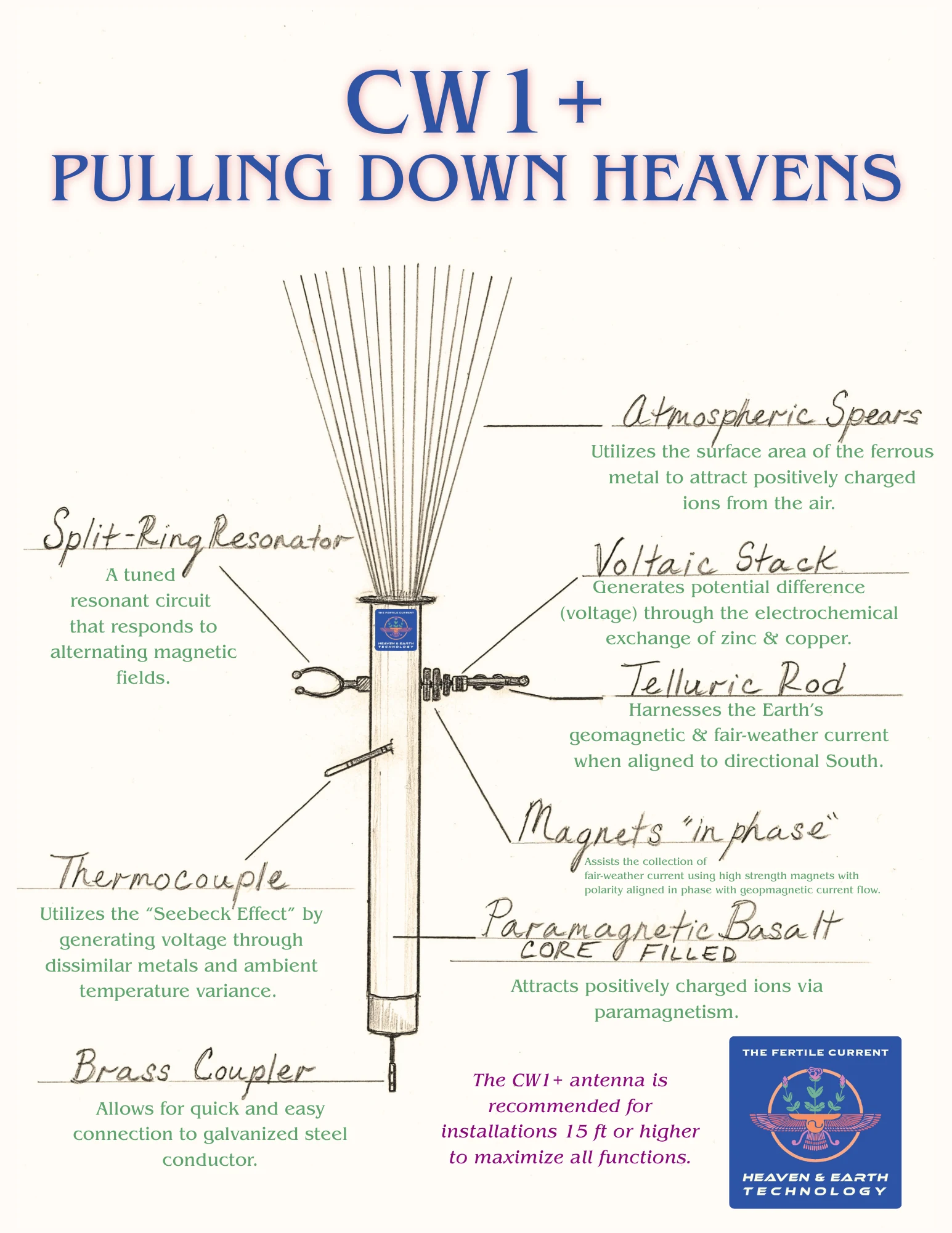
Copper body
The body of the antenna carries the charge. All electrical parts are soldered together inside, by hand.
Paramagnetic basalt core
The copper body is filled with basalt rock. Basalt is paramagnetic, weakly magnetic through its iron, and it is there to help attract positive ions.
Atmospheric spears
A fan of thin steel spears. Plenty of surface and plenty of points to meet the air and gather positive charge.
Voltaic pile
The antenna’s own little battery, on the side of the body. Layers of zinc and copper make a small voltage of their own, and work harder after rain.
Thermocouple (Seebeck effect)
A small part on the side of the body. Two different metals joined together turn the warm-and-cool changes in the air into a little extra voltage.
Brass telluric rod
Connects the antenna to the Earth’s own natural ground currents. Aligned to the South.
Rare-earth magnets “in phase”
Strong magnets lined up with the Earth’s field to help collect the fair-weather current and focus the magnetic side of the system.
15 cm split-ring resonator
An open ring, also called a Lakhovsky coil, tuned like a tuning fork. Its gap faces North and its angle is adjustable for tuning.
Heavy-gauge copper wire
The main wire is thick copper, so the charge keeps moving freely.
Internal soldering
Every electrical joint inside is soldered, so connections stay solid season after season.
Copper and brass hardware
Metals chosen to last outdoors, with stainless steel only for the small set screw.
Brass coupler
Joins the antenna quickly and easily to the galvanised steel ground wire.
Jargon buster
Voltage (potential difference)
The “push” behind electricity.
Picture two water tanks at different heights joined by a pipe. The bigger the difference in height, the harder the water pushes. Voltage is that push, measured in volts. This is why height matters for the antenna: the higher it reaches, the bigger the difference between the sky and the ground, like a taller tank pushing harder.
What it does here: The difference between the sky end (+) and the earth end (−) is the push that drives the whole circuit. On a fair day the air gains roughly 100 volts for every metre of height.
Current
The flow itself.
The water actually running along the pipe. Voltage is the push; current is what flows because of it.
What it does here: The flow that travels down the wire and round the Heaven–Earth loop.
Conductor
A material electricity flows through easily.
Copper, brass and steel are conductors. Rubber and plastic are the opposite (insulators), which is why wires are wrapped in plastic. A conductor does not pull charge in by itself. It is the road, not the magnet. The pull comes from the voltage difference, and the spears’ many points help gather the charge.
What it does here: The copper body and wire carry the charge down from the spears, and the galvanised steel wire carries it on into the soil.
Capacitor
A small rechargeable bucket for electric charge.
Two metal plates with a gap between them. One side collects positive charge and the other negative, ready to release it.
What it does here: The Earth and the upper atmosphere work like a giant natural capacitor. The Earth is the negative plate, the upper atmosphere is the positive plate, and the air between is the gap. Thunderstorms keep recharging it, and the faint fair-weather current is a slow leak between the plates. The antenna and the ground wire are designed to tap into that flow. The Elixir Field amplifier in our range also contains real capacitors and diodes.
Flux (magnetic flux)
How much magnetism passes through a loop.
Imagine rain falling through a hoop: more rain through the hoop is more flux. When the flux changes, it can create a small voltage in a coil. In everyday speech, “fluxing” just means flowing and changing, and in electroculture it describes the sky-to-ground voltage rising and falling, like the tide.
What it does here: The rising and falling voltage makes the magnetic field around the coil and magnets change too. That changing amount is the flux, and a changing flux makes a small extra voltage in the wire.
Coil
Wire wound round and round.
Coiling a wire stacks the magnetism from every turn in one place, so the effect is stronger. A changing magnetic field makes a voltage in it, which is how bike dynamos and wireless phone chargers work. Do not confuse it with the split-ring resonator, which is an open ring, not a wound coil.
What it does here: In the drawing, the coil wound round a magnet shows the general idea: when the sky-to-ground voltage rises and falls, the field changes and a small extra voltage appears in the wire. In our range the magnetic side is the aligned magnets in the antenna and the optional boosters on the ground wire. The coil inside the Heaven–Earth circle is the same idea drawn as a symbol.
Ferromagnetic
Strongly attracted to magnets.
Iron, steel and nickel. A fridge magnet clings to a steel door because steel is ferromagnetic. These materials can also be magnetised and become magnets themselves, and that is where strong magnets, including rare-earth ones, get their power.
What it does here: The steel spears, the rare-earth magnets in the antenna and the galvanised steel ground wire are all ferromagnetic. The idea, from our Toroidal Field guide, is that an iron-based ground wire couples most directly with the Earth’s own field, which is generated by the iron-rich core deep inside the planet.
Diamagnetic
Very slightly pushed away by magnets.
Copper, water, most plants and most living things. The push is so tiny you can’t feel it, but it’s there. The opposite of a fridge magnet sticking.
What it does here: Plants, soil water and the copper and brass parts of the antenna are diamagnetic.
Paramagnetic
Very slightly pulled towards magnets.
Weaker than iron, and only while the magnet is close. Many rocks and minerals are like this, including basalt, because of the iron they contain. A fridge magnet will not lift it. It takes a very strong magnet to show the pull, and some basalt has tiny magnetite specks that do cling.
What it does here: Basalt rock dust, and the basalt core of the CW1+ antenna, are paramagnetic.
Ions: cations and anions
Any atom or particle carrying a tiny electric charge.
Lose an electron and it becomes positive, a cation (+): the “t” in cation looks like a plus sign. Gain one and it becomes negative, an anion (−). Opposites attract. Plant foods such as calcium and nitrate are ions in soil water.
What it does here: Positive cations in the air, negative anions at the earth end.
Ground (earth) symbol
“This wire connects to the earth.”
Three short stacked lines is the electrician’s sign for it. In an electroculture circuit, it marks where the system connects into the soil.
What it does here: Marks the earth connection on the right of the diagram.
Yin and Yang
Two opposite, balancing qualities.
From Chinese philosophy. Yang is active, rising and sky-like. Yin is receptive, settling and earth-like. The diagram uses them to name the two ends of the circuit.
What it does here: “Greatest Yang” sits at the antenna, “greatest Yin” at the earth.
Electric vs magnetic
Two different pulls.
Electric is charge pulling on charge: opposites attract, like the static that makes your hair stand up after rubbing a balloon. Magnetic is what a magnet does to iron. They are close cousins: a moving electric current always makes a small magnetic field around it.
What it does here: The pull on the positive ions in the air is electrical. The magnets and coil lower down are the magnetic side.
Rare-earth magnets
Very strong small magnets.
Made from metals such as neodymium, they are far stronger than a fridge magnet for their size. “Aligned” means they are all lined up the same way, with their north and south poles facing the same direction.
What it does here: The antenna contains directionally aligned rare-earth magnets, lined up with the Earth’s own field.
Torus (a donut-shaped field)
A field that loops round like a donut.
The Earth’s own magnetic field is donut-shaped, as is the field around a magnet, and the electrical field of the heart, which doctors read every time they take an ECG. The loop leaves one end, curves round and re-enters at the other, so nothing is a dead end.
What it does here: The antenna, the ground wire and the soil are designed to form this same loop in miniature. (The donut shape of every magnetic field is Ken Wheeler’s model; the Earth’s field being donut-shaped is mainstream geophysics.)
Induction
A changing magnetic field makes a voltage.
Move a magnet in and out of a coil of wire and a small voltage appears in the wire, but only while the magnet is moving. Bike dynamos and wireless phone chargers work this way. A perfectly steady field makes nothing.
What it does here: The fluxing voltage between sky and ground makes the magnetic field change, which makes a small extra voltage in the wire.
Solar wind
A stream of charged particles flowing out from the sun.
It is what makes the northern lights, and it pushes the Earth’s magnetic field around, which in turn drives faint currents through the ground and the upper air.
What it does here: The cation-collecting wire array on the CW antennas is described as harnessed from solar winds.
Rhizome layer
The root zone of the soil.
The layer of soil around and just below the plant roots, where roots, fungi and microbes swap food and water. Gardeners often simply call it the root zone.
What it does here: The galvanised ground wire is laid just below it, about 20–30 cm down.
Words on the antenna diagram
Alternating (back-and-forth)
Switching direction again and again.
Mains electricity does this 50 times a second. Think of pushing a swing: forward, back, forward, back. The opposite is a steady one-way flow, like a battery gives.
What it does here: The split-ring resonator on the antenna responds to magnetic signals that go back and forth like this.
Split-ring resonator (Lakhovsky coil) and resonance
A small open metal ring (not a wound coil), tuned to one “note”.
Like a child’s swing pushed at just the right moment, or a tuning fork that hums when the matching note sounds, it responds strongly to magnetic signals of just the right pitch and mostly ignores the rest. That matching is called resonance. Think of tuning a guitar string or a radio dial: out of tune, the sound is weak or fuzzy, and in tune it rings out clearly. The ring’s angle can be adjusted to tune it, and the small gap in the ring uses the air as a tiny capacitor.
What it does here: Sits on the antenna and answers alternating magnetic fields. Its gap faces North, opposite the telluric rod.
Voltaic stack: the antenna’s own little battery
The first battery ever made, about 1800.
Layers of two different metals with something damp between them make a small voltage. This one uses zinc and copper, like a stack of pancakes with syrup in between. Named after Alessandro Volta, who made the first one: the words volt and voltage come from his name too.
What it does here: Mounted on the side of the antenna, next to the telluric rod. It adds its own small voltage to the circuit, and works harder after rain.
Thermocouple and the Seebeck effect
Two different metals joined together make a tiny voltage when one end is warmer than the other.
This is called the Seebeck effect. It is how some oven and car thermometers work.
What it does here: A small part on the side of the antenna. It turns the warm-and-cool changes in the air through the day into a little extra voltage. It is not the same as the brass coupler at the bottom, which connects the antenna to the ground wire.
Telluric current and the telluric rod
“Telluric” means of the earth: faint electricity flowing through the ground.
These currents flow in wide, slow sheets and are driven by shifts in the Earth’s magnetic field, which the sun pushes around. Geologists measure them (a method called magnetotellurics) to map rock, water and minerals underground. In big solar storms they can even show up in power lines and pipelines.
What it does here: In plain words: the rod is the antenna’s link to the Earth’s own natural currents. The brass telluric rod sticks out from the side of the antenna, opposite the resonator ring, and points South. Brass is copper mixed with zinc, a good conductor that lasts outdoors. Chris describes it as harnessing the Earth’s geomagnetic and fair-weather current. In the loop picture it is the earth-side leg: current drawn up through the rod while the antenna draws charge down.
Fair-weather current
A thin, steady trickle of electricity from the upper air down to the ground.
It flows on calm days, away from storms, and it is tiny, only a few trillionths of an amp per square metre. But it is real, and scientists measure it. It is the slow leak in the Earth-and-atmosphere capacitor, and thunderstorms around the world keep recharging that capacitor, so the trickle never runs out.
What it does here: This is the natural flow the antenna is designed to work with.
Geomagnetic field and polarity
The Earth is like a giant bar magnet, with its field running North–South.
A compass needle follows it. “Polarity” just means which end of a magnet is North and which is South. Opposite poles attract; like poles push apart.
What it does here: The antenna’s magnets are lined up “in phase” with the Earth’s field, so they work with it, not against it.
Galvanized steel and brass
Steel coated in zinc so it doesn’t rust, and a rust-resistant yellow metal made of copper and zinc.
Both carry electricity well and last a long time outdoors and underground.
What it does here: Galvanized steel is the conductor in the ground. The brass coupler joins the antenna to it quickly.
Points and surface area
Sharp points and lots of thin spears give a metal more surface to meet the air.
Electric charge gathers at sharp points. That is why lightning rods are pointed.
What it does here: The idea behind the bundle of thin “atmospheric spears” on top of the antenna.
The golden ratio (φ)
A proportion of about 1.6 to 1.
It turns up across nature, from sunflower seed heads to pine cones, and has been used in art and building for centuries. It has a special maths property: 1 ÷ φ = φ − 1, so it keeps nesting into itself.
What it does here: The idea in our Toroidal Field guide is that the loop grows and shrinks by this ratio, which is why the circuit keeps cycling.
Piezoelectric
Makes a tiny voltage when squeezed or bent.
Quartz crystals do this. It is how a gas lighter makes its spark and how a quartz watch keeps time.
What it does here: The CW2+ antenna has dual tensor rods that produce piezoelectric current.
CEC (cation exchange capacity)
How well soil can hold plant food.
Soil particles carry a negative charge, so they hold positively charged nutrients such as calcium, potassium and magnesium, and hand them to roots when needed. A soil with a higher CEC holds more. It is a standard number on a soil test.
What it does here: How it works: the small induced voltage raises the soil’s CEC, so more nitrogen is made available and less feed is needed. Growers report greener, more vigorous plants.
Try it at home
Hold a fridge magnet to a steel nail or a steel spoon: it clings. That is ferromagnetic. Now try it on a copper wire, a banana or a houseplant leaf: nothing happens that you can feel. Those are diamagnetic. You have just sorted materials by their magnetic behaviour, the same words used in the diagram.
Ready to see the equipment?
See each part in place on the CW1+ and CW2+ antennas, watch an installation, or read how the whole system works in Chris Winters’ own words.
Electroculture is a traditional gardening practice, and results depend on your soil, your climate and how well the circuit is set up. Ideas credited to Chris Winters (The Fertile Current), Ken Wheeler (Theoria Apophasis) and Philip Callahan (Paramagnetism). © The Living Field. Explanations, layout and graphics by The Living Field. Hand-drawn diagrams © The Fertile Current (Chris Winters). Please don’t copy or republish without permission. You’re welcome to share a link.